Level of difficulty: Intermediate Cost to attend: None
Project: A Cleveland Yale Club project to interest and motivate kids in Cleveland’s inner city schools to become engineers. Many of these students know nothing about engineering careers. (The same idea of bringing alumni and their friends in a variety of jobs and careers to kids in schools in person, on the web and using YouTube also can be done.)
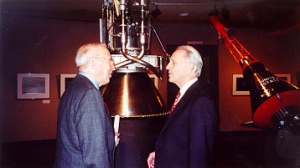
Pete Staudhammer with Jim Lovell and the rocket engine used to rescue Apollo 13 and land Neil Armstrong on the moon
Lead time: 2 months Date of event: Spring 2007
Resources:
1 lead volunteer – 5 hours
1 volunteer (non-alumni) speaker – 2 hours (preparation and presentation)
1 museum director – under 2 hours
3 city school staff (teachers/administrators) – 10 hours
Results: 100 public school students heard live, over 1,100 people subsequently viewed video
Why a success? A local engineer with an international reputation (Pete Staudhammer) told the story of the six Apollo moon landings, including the Apollo 13 rescue, and of the engineering that got astronauts to the moon and back. He included stories of his 40 year career as an engineer. The story was told on live video, while standing in front of the TRW rocket engine at the Cleveland Museum of Natural History while the kids were 10 miles away – 4th graders and 5th graders, about 100 in total.
The school principal told us that the students were “on the edge of their seats.”
Further, to capture the event for use more than one time and for others to see, Cleveland Schools videotaped it and we made a short video that other kids, teachers and anybody that wasn’t there could watch. It is still on YouTube: http://www.youtube.com/watch?v=28IhhuTlmLM .
Finally, we talked Pete into writing and publishing “One Practicing Engineer’s 40+ Year Experience: Meta Standards and Math-Science Principles.”
Details: Five of us in the Yale Club of Cleveland were partnering with a Cleveland public elementary school doing tutoring and other traditional school-service projects, when we realized we had a special opportunity to motivate some of the students to become engineers. We knew they, like most, did not really know what an engineer is or does, or what a career in engineering might be like.
The special opportunity was to have a friend and the Chief Scientist for TRW Inc. in Cleveland, Pete Staudhammer, talk with kids in the school about something they could not forget.
Pete, who as TRW’s Top Scientist worked with 70,000 engineers and other scientists around the world, in the 1960s had been the chief engineer for TRW when they designed and built the rocket engine for the Apollo moon landing module.
This rocket engine took the Apollo astronauts out of orbit around the moon and landed them safely in six separate Apollo missions. Most dramatically, when Apollo 13 blew up on the way to the moon, Pete’s rocket engine was used in the rescue of Jim Lovell and the other astronauts (see the picture below).
Pete Staudhammer with Jim Lovell and the rocket engine used to rescue Apollo 13 and land Neil Armstrong on the moon
For the school, some of the problems we had to overcome were that the TRW rocket engine was on display at the Cleveland Museum of Natural History, the elementary school was 10 miles away, and there was no money to pay for either a bus to take the students there nor to pay their admission fee. Our solution was to do a live webcast from the Museum to the school, which cost nothing.
Resource use: It only took one alum, one friend, three interested people at Cleveland Schools and the Director of the Cleveland Museum of Natural History to make this happen. The alum’s time was about 5 hours for this project. The school executive who arranged the internet connection between the museum and the school spent about 5 hours, since the Cleveland Schools’ internet system was fragmented and complex at that time. The school video editor’s time was 3-5 hours. Time spent by the school principal, the Museum Director and Museum staff time was small. The cash cost was zero.
It took 2 months to arrange, and with a high-level champion in the school district. At the time the Cleveland schools had no way to easily connect with the Museum on the Internet. Today, it might be both easier to do and quicker to arrange.